

Step Down Transformers in Kenya: The Complete Buyer’s Guide (240V to 110V)
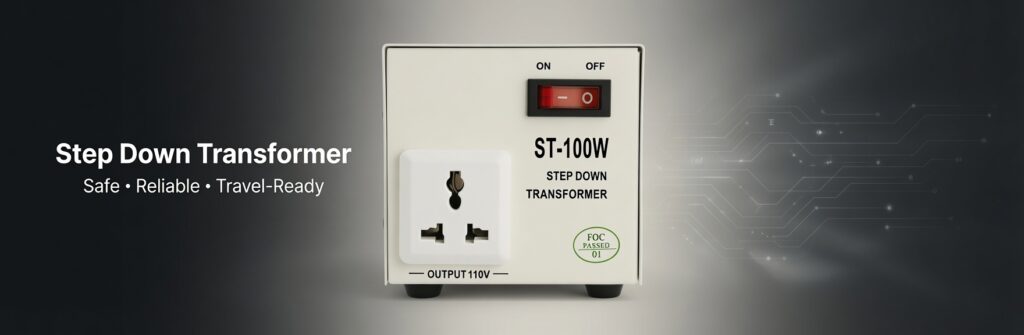
Complete Buyer’s Guide (240V to 110V)
If you’ve just received an appliance from the US, Canada, or Japan – a treadmill, kitchen mixer, gaming console, medical device, or industrial machine – and you’ve plugged it into a Kenyan socket, you already know what happens. The device either refuses to work, overheats, or burns out entirely.
Kenya runs on 240V AC power. The United States, Canada, and Japan run on 110V–120V. That voltage gap is what a step down transformer is built to bridge.
This guide covers everything: how step down transformers work, how to choose the right size for your appliance, what they cost in Kenya, and what to avoid when buying one. If you already know what you need, you can browse all step down transformers available in Nairobi here.
What Is a Step Down Transformer?
A step down transformer is an electrical device that reduces high-voltage alternating current (AC) to a lower, safer voltage. In Kenya’s case, it converts 240V from the mains supply down to 110V or 120V – the standard voltage used by appliances built for the US, Canadian, and Japanese markets.
It works through electromagnetic induction. The transformer has two coils of wire wound around a magnetic core – a primary coil (connected to your 240V mains supply) and a secondary coil (connected to your appliance). The primary coil has more turns of wire than the secondary. This ratio determines how much the voltage is stepped down.
NOTE: No electronics, no conversion chips. A transformer simply uses the laws of physics to reduce voltage safely and quietly. That’s why quality transformers last for many years with zero maintenance.
Do You Actually Need a Step Down Transformer in Kenya?
Not every imported appliance needs one. Here’s how to know for sure.
Check the label on your device — usually found near the power input, on the base, or in the manual. Look for a line that says something like:
- “Input: 110V ~ 120V” → You MUST use a step down transformer in Kenya
- “Input: 220V ~ 240V” → You do NOT need one (it already matches Kenya’s supply)
- “Input: 100V ~ 240V” or “100–240V” → Dual voltage. You only need a plug adapter, not a transformer
The vast majority of appliances shipped from the US are single-voltage 110V and will be destroyed if plugged directly into Kenya’s 240V supply. This includes treadmills, kitchen equipment, medical devices, power tools, entertainment systems, and office machinery brought in from the US market.
How to Choose the Right Size Step Down Transformer
This is where most people get it wrong, and it’s the most important decision you’ll make.
Step 1: Find Your Appliance’s Wattage
Check the label or user manual for the wattage rating (marked as W or VA). If you see amps (A) instead, calculate watts using:
Watts = Amps × 110V
Example: 5A × 110V = 550W
Step 2: Apply the Safety Multiplier
You should never buy a transformer rated at exactly your appliance’s wattage. Here’s why:
For standard electronics (TVs, audio, computers, monitors):
Choose a transformer rated 1.5× to 2× your appliance wattage
Example: 500W TV → buy a 750W or 1000W transformer
For motor-driven appliances (treadmills, blenders, refrigerators, washing machines, power tools, air conditioners):
Choose a transformer rated 3× to 4× your appliance wattage — motors draw a large surge of power at startup that can trip or damage an undersized transformer
Example: 1,000W treadmill → buy a 3,000W or 4,000W transformer
For heating appliances (coffee makers, toasters, rice cookers, microwaves, air fryers):
Choose a transformer rated 2× to 3× your appliance wattage
Example: 1,200W microwave → buy a 2,500W or 3,000W transformer
Step 3: Match to the Right Transformer Size
| Appliance | Typical Wattage | Recommended Transformer |
| Phone charger / shaver | 10W – 30W | 100W |
| Laptop | 45W – 120W | 200W – 300W |
| Gaming console (PS5, Xbox) | 100W – 200W | 300W – 500W |
| Router / small printer | 50W – 150W | 300W |
| Desktop computer | 200W – 500W | 500W – 1000W |
| LED TV (40–65 inch) | 80W – 200W | 300W – 500W |
| Hair dryer | 1,200W – 1,800W | 2,500W – 3,000W |
| Coffee maker | 800W – 1,200W | 2,000W – 3,000W |
| Air fryer | 1,200W – 1,700W | 2,500W – 3,500W |
| Microwave oven | 700W – 1,500W | 2,000W – 3,000W |
| KitchenAid mixer | 300W – 600W | 1,000W – 1,500W |
| Treadmill (home use) | 750W – 2,000W | 3,000W – 5,000W |
| Laser printer | 400W – 1,500W | 1,500W – 3,000W |
| Power drill | 500W – 1,200W | 2,000W – 3,500W |
| Refrigerator (US import) | 100W – 400W | 1,000W – 1,500W |
| Washing machine | 500W – 1,000W | 2,000W – 3,000W |
| Medical equipment | Varies | Always consult supplier |
| Industrial machinery | 2,000W – 10,000W | 5,000W – 15,000W+ |
Step Down Transformer Prices in Kenya (2026)
Prices vary based on wattage capacity and build quality. Here’s an honest breakdown of what to expect:
| Wattage | Typical Price Range (KSh, excl. VAT) | Best For |
| 100W – 300W | 2,500 – 5,000 | Laptops, chargers, consoles |
| 500W – 750W | 4,500 – 7,000 | Small appliances, audio |
| 1,000W | 7,500 – 12,000 | Office equipment, printers |
| 1,500W – 2,000W | 10,000 – 18,000 | Kitchen appliances, treadmills |
| 3,000W | 18,000 – 25,000 | Heavy kitchen, workshop tools |
| 4,000W – 5,000W | 28,000 – 45,000 | Industrial tools, servers |
| 8,000W – 10,000W | 55,000 – 75,000 | Industrial systems |
| 15,000W | 75,000 – 90,000 | Factories, heavy machinery |
At Fedi Office Supplies, we stock the full range from 100W to 15,000W. View current step down transformer prices in Nairobi →
Types of Step Down Transformers We Stock in Nairobi
- Portable / Light-Duty (100W – 500W)
Compact and lightweight. Ideal for personal electronics like laptops, phone chargers, shavers, routers, and gaming consoles. A popular choice for expats and travellers using personal devices brought from the US or Japan.
- Mid-Range / Home & Office (750W – 3,000W)
The most commonly purchased category in Kenya. Covers the majority of imported kitchen appliances, audio-visual systems, printers, projectors, and home fitness equipment. If you’re not sure which you need, most household needs fall in the 1,000W – 2,000W range.
- Heavy-Duty / Industrial (4,000W – 15,000W)
Built for continuous heavy use. Used in manufacturing, medical facilities, NGO operations, server rooms, and industrial workshops. These units run 24/7 without overheating, feature reinforced copper windings, and include multiple output sockets for powering several machines simultaneously.
- Dual-Purpose (Step Up / Step Down)
Some models can both step voltage up and down, useful for organisations that ship equipment between Kenya and the US frequently.
What to Look for When Buying a Step Down Transformer in Kenya
Not all transformers are equal. Here’s what separates a quality unit from a cheap one that will fail — or worse, damage your appliance:
Copper windings, not aluminium
Copper conducts electricity more efficiently and generates less heat. Cheaper units cut costs by using aluminium windings, which leads to overheating and shorter lifespan. Always ask or verify.
Built-in thermal overload protection
This automatically cuts power if the transformer overheats, protecting both the unit and your appliance.
Short-circuit protection
Protects against sudden power spikes from Kenya’s mains supply, which can fluctuate significantly especially during grid switching.
50Hz / 60Hz compatibility
Kenya runs on 50Hz. Appliances from the US are built for 60Hz. This rarely causes issues for electronics, but for motor-driven devices (fans, blenders, some clocks), speed may vary slightly. A quality transformer should handle both frequencies without issues.
Correct wattage headroom
As detailed above, a transformer running at or near its maximum rated wattage continuously will fail faster. Always buy with a 50%–200% margin depending on the load type.
Common Mistakes Kenyans Make When Buying Step-Down Transformers
Buying by price alone.
A 1000W transformer priced at KSh 3,000 when the market rate is KSh 8,000 is probably using aluminium windings and will fail within months. The transformer is protecting a device worth far more — buy the right one.
Undersizing for motors.
The most common mistake. A 1,500W treadmill doesn’t need a 1,500W transformer — it needs a 3,000W to 4,500W unit to handle the startup surge safely.
Using a converter instead of a transformer for motor appliances.
Cheap electronic converters (not true transformers) work fine for simple resistive loads like light bulbs. They are not suitable for motors, heating elements, or sensitive electronics. For anything with a motor, always use a genuine iron-core transformer.
Plugging dual-voltage devices into a transformer unnecessarily.
If your MacBook charger or phone charger says “100–240V” on it, you don’t need a transformer at all just a plug adapter. Running a dual-voltage device through a transformer adds unnecessary load.
Overloading one transformer with multiple appliances.
You can run multiple devices from one transformer, but the combined wattage of all devices must not exceed the transformer’s rated capacity.
Who Uses Step Down Transformers in Kenya?
The demand for step-down transformers in Nairobi and across Kenya comes from a wide range of users:
Returning diaspora and expats
Kenyans returning from the US, and foreign nationals working in Nairobi, bring American-standard appliances that need voltage conversion to work locally.
Businesses and offices
Organisations that import US office equipment: servers, specialist printers, lab equipment, audio-visual systems, and telecommunications hardware.
NGOs and development organisations
Many NGOs operating in Kenya source equipment from the US. Step down transformers are a standard procurement item for project sites nationwide.
Industrial and manufacturing
Factories and workshops using imported American machinery require heavy-duty step down transformers rated in the thousands of watts.
Medical facilities
Hospitals and clinics using imported diagnostic or therapeutic equipment from the US require stable voltage conversion. These applications demand the highest-quality units with clean, regulated output.
Gyms and fitness centres
US-sourced treadmills, ellipticals, and commercial fitness equipment all run on 110V and need reliable step down conversion.
Step Down Transformer vs. Voltage Converter: What’s the Difference?
These terms are sometimes used interchangeably, but they’re not the same thing.
A voltage converter is typically a small, lightweight electronic device that switches current rapidly to simulate a lower voltage. They are cheap, compact, and fine for simple resistive loads (lamps, phone chargers, shavers). They are NOT suitable for motors, heating elements, or sensitive electronics.
A step-down transformer uses electromagnetic induction and has no active electronic components. It produces a stable, true sine wave output that is safe for motors, heating appliances, medical devices, and sensitive electronics. It’s heavier and more expensive, but it’s the right tool for the job.
If your appliance has a motor, a heating element, or is high-value electronics, always use a proper step down transformer not a converter.
Frequently Asked Questions
What is the difference between 110V and 120V?
They are used interchangeably in most cases. US appliances rated at 110V, 115V, or 120V will all work safely with a step down transformer set to 110V–120V output.
Can I use a step down transformer for a treadmill in Kenya?
Yes, but make sure you buy a transformer rated at 3 to 4 times the treadmill’s motor wattage. A 1,500W treadmill needs a minimum 4,500W transformer. We stock heavy-duty units suitable for all gym and fitness equipment.
What size transformer do I need for a PS5 or Xbox in Kenya?
The PS5 draws approximately 200W under load. A 500W step down transformer provides a sufficient safety margin. See our 500W transformers here →
Is it safe to leave a step down transformer on overnight?
Quality transformers with thermal protection can run continuously, but it’s best practice to switch off when the device is not in use. Never cover a running transformer it needs ventilation.
Can I use one transformer for multiple appliances?
Yes, provided the combined wattage of all connected devices does not exceed the transformer’s rated capacity. Add up all device wattages and buy a transformer with at least 50% headroom above the total.
Do I need a step down transformer for a MacBook or laptop from the US?
Most modern laptop chargers and MacBook adapters are dual-voltage (100–240V) and do not require a transformer only a Type G plug adapter for Kenya’s sockets. Check your charger’s label to confirm.
What is the price of a 1000W step down transformer in Kenya?
A quality 1,000W step down transformer in Kenya typically costs between KSh 7,500 and KSh 12,000 excluding VAT. Check current stock and prices at Fedi →
Do you deliver step down transformers outside Nairobi?
Yes. We offer same-day delivery within Nairobi CBD and 24–48 hour delivery to all major towns across Kenya including Mombasa, Kisumu, Nakuru, Eldoret, Thika, and Nyeri.
Buy Step Down Transformers in Nairobi From Fedi Office Supplies
Fedi Office Supplies is an established electronics and IT supplier based in Nairobi’s CBD. We stock over 60 step down transformer models ranging from 100W to 15,000W — portable units for home use all the way to heavy-duty industrial transformers.
Every unit we sell comes with:
- Genuine copper-wound cores for efficient, long-lasting performance
- Built-in thermal overload and short-circuit protection
- 50Hz/60Hz compatibility
- Technical support to help you choose the right size
📍 Location: Town House Building, Kaunda Street, 6th Floor, Room 606, Nairobi CBD
📞 Call/WhatsApp: +254 114 158 465 | +254 791 386 881
📧 Email: sales@fedi.co.ke
Browse All Step Down Transformers in Nairobi →
Fedi Office Supplies — Your trusted step down transformer supplier in Nairobi, Kenya.